 Ελληνικά
A Harvest to Remember — The 2025 Vintage at Vlassides Winery
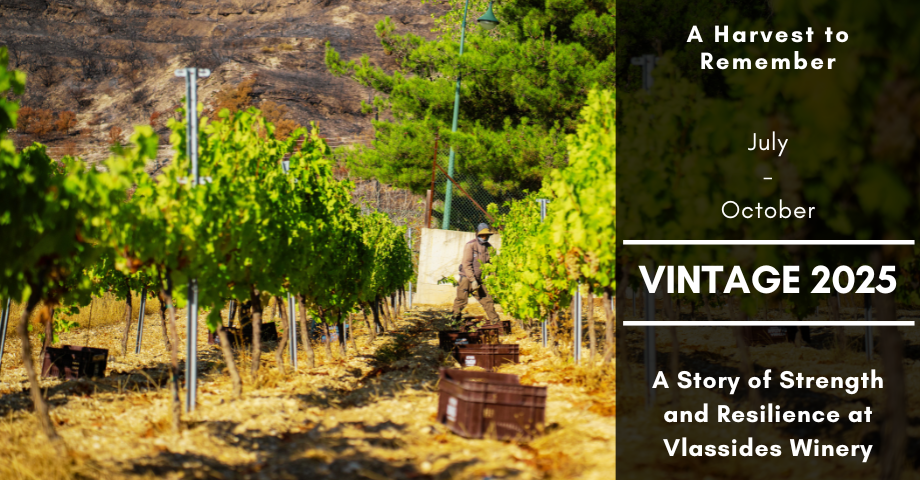
Strength and Resilience: The 2025 Harvest at Vlassides Winery
In July 2025, the wildfires that broke out in the wine villages of Limassol left behind a deeply scarred landscape. Amid the ashes, vineyards often stood on the very front line of destruction. Vines that were waiting for the harvest were burned before they had the chance to bear their fruit.
During the fires, however, vineyards often acted as natural firebreaks. Thanks to their low vegetation, the moisture retained within the vines, the spacing between plants and the cultivated soil surrounding them, the flames struggled to spread. In areas where vineyards were well maintained, the fire lost intensity or stopped entirely, helping protect nearby villages, properties, other crops and, in many cases, the vineyards themselves.
Our own vineyards, located between the villages of Koilani and Vouni, were mainly affected by heat stress due to the proximity of the flames. This resulted in partial or total leaf loss in vines situated very close to the fire. These vines were primarily located around the perimeter of our vineyards and, in many ways, acted as a protective barrier, preventing the fire from spreading further into the vineyard blocks. Two of our vineyards, planted with Shiraz and Agiorgitiko and located directly along the path of the fire, suffered complete defoliation and total loss of fruit.
Vineyards that experienced severe heat stress and loss of foliage were not harvested, mainly due to the interruption of the photosynthetic process responsible for sugar production in the grapes.
In the remaining vineyards, our observations so far have not indicated serious damage to the plants’ vascular system, which is responsible for transporting water and nutrients throughout the vine. According to existing research and the limited experience available from vineyard exposure to wildfires, recovery of vineyards that have suffered moderate to severe heat stress typically requires approximately two to three years before returning to full production.
Another concern when vineyards are exposed to nearby fires is the potential absorption of smoke compounds through the grape skins. These compounds may later be transferred into the wine, resulting in undesirable aromas and flavours reminiscent of burnt wood, ash or smoke. For this reason, we chose not to leave anything to chance. Samples of grapes from vineyards located close to the fires were collected and sent abroad for laboratory analysis. The results confirmed that no significant concentrations of these unwanted compounds were detected.
The 2025 harvest was therefore marked by reduced yields due to both the fires and the dry conditions of the season, but also by remarkable fruit quality. This once again confirmed the resilience and potential of our indigenous, own-rooted varieties under conditions of intense climatic stress.
This year, harvesting at the winery began earlier than usual, during the last week of July, in order to minimize any potential negative effects that the fires could have had on grapes approaching ripeness, such as Sauvignon blanc. Reduced nutrient supply to the fruit due to leaf loss could have led to berry dehydration if harvesting had been delayed.
Compared to the previous year, total rainfall was reduced by approximately 15%. The recorded period from November 2024 to October 2025 reached a total of 517.4 mm of rainfall, although its distribution throughout the year was uneven. During November and December 2024 alone, 307.9 mm of rain were recorded—more than half of the total rainfall for the entire period—while the summer months were marked by complete drought.
The mild winter favoured an early start to the growing season. Rising temperatures in March led to budburst for several varieties by mid-month, including Agiorgitiko, Chardonnay, Maratheftiko, Xynisteri and Giannoudi. Budburst across all varieties was completed within the first ten days of April.
Limited spring rainfall, combined with relatively cool spring temperatures, resulted in flowering beginning around mid-May. From veraison to harvest, temperatures were noticeably higher than the seasonal average. These conditions significantly limited fungal diseases and contributed to the excellent health of the grapes, as many humidity-driven pathogens were absent. At the same time, the warm conditions accelerated sugar accumulation, helped maintain high natural acidity in white varieties and contributed to greater phenolic concentration and intensity in the red grapes.
As we conclude the 2025 harvest report, we would like to remember that for the people of the wine villages, vineyards are far more than a crop or a source of income. They represent memory, identity and a way of life. Every vine carries with it stories, hard work and a deep connection to the land. The fires of this year left behind scars, but they did not break this bond. With patience, care and faith in the rhythm of nature, the vineyards will grow strong again, and the hills of the wine villages will once more turn green—reminding us that even after the most difficult moments, life and hope always find their way back.